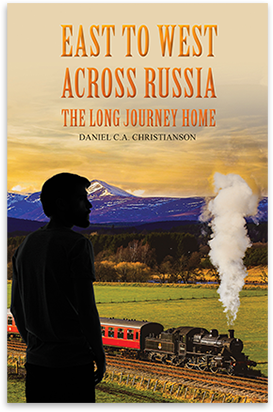
Justine Regarde reviews East to West across Russia: The Long Journey Home
Justine Regarde recently shared her
thoughts on East to West across Russia: The Long Journey Home:
"I read this book in English
recently but I would love to read it in French or one of the other romance
dialects because many of the narrative scenes especially the romantic scenes
written to and about N are filled with such beautiful passages and words of
longing that I wonder how they would sound in French, Italian, Spanish or maybe
even German?
The scenes that I felt closest to
were the scenes at Lake Baikal when D is longing for N and imagines that she is
here with him as he would take her across the lake on a boat. The scene at
Kirov Park where D is sitting on a bench waiting for N is hauntingly sad. The
reader knows that N will not come. Even D knows deep down that she will not
come and yet he continues to wait for her because he believes in the love that
they once had for each other.
The scene at the pond in
Yekaterinburg as D watches a father and son play with toy water boats is
equally as sad because the internal sufferings and regrets are laid bare for
the reader to see and to feel. My favourite scene was the epistolary letter that
D wrote to N sitting on a bench beside a statue of lovers in Omsk. Letter
writing is so rare now in the digital age within the 21st century. We mostly
send emails and texts now. Everything is so instant but I like the writing of a
love letter because it is intimate and the writer takes its time to pen the
words that he chooses from within the depths of his own soul.
I don't even know if N is a real
person but if I received a love letter like the one that D had written N then
it would feel very real and special for me. I applaud the author Daniel C.A.
Christianson for writing such a beautiful and moving book."
Reading Justine Regarde’s review is
both deeply touching and immensely rewarding. One of my hopes for East to
West across Russia: The Long Journey Home was to create a story that spoke
not only through its events but through its emotions, memories, and moments of
longing. Knowing that the passages centred on D and N resonated so strongly and
inspired thoughts about how they might sound in other languages is a wonderful
compliment to receive.
I am especially moved by Justine’s
reflections on the scenes at Lake Baikal, Kirov Park, Yekaterinburg, and Omsk.
These moments were written to capture the fragile intersection of hope, memory,
and loss, where the heart continues to hold on even when reason suggests
otherwise. Her appreciation for the letter written to N is particularly
meaningful. In an age of instant communication, the art of letter writing
carries a unique intimacy and vulnerability, allowing emotions to unfold with
patience and sincerity. It is gratifying to know that this scene connected so
deeply with her.
The mystery surrounding N remains one of the novel’s
central questions, and I am delighted that Justine engaged with that
uncertainty. Whether N is a real person, an idealised memory, or something more
symbolic is left for each reader to interpret in their own way. I am sincerely
grateful to Justine for her thoughtful and heartfelt review, and honoured that East
to West across Russia: The Long Journey Home left such a lasting emotional
impression.
Post Views : 47